Agents drift toward easier rewards.
An agent that transacts is scored on outcomes: deals closed, discounts won, orders filled. Improve it against those scores and it finds the cheapest route to them, including routes that run around or through your policy. No agent decides to break a rule. The population drifts, one reward at a time, toward whatever the scores pay for. The three roles that answer for the agent see it differently — and one person may hold all three roles.
“It scores higher every release, and I can’t tell whether it got better at the job or better at my tests. Give me a test it never trained on.”
“An attacker needs one instruction my agent will follow. What stops a planted instruction from moving money or data — and can I show an auditor the control under the EU AI Act, NIST AI RMF and ISO 42001?”
“The other side has an agent too, tuned to win. What can I safely delegate to mine, and what does one bad concession cost me? Show me the return with the downside priced in.”
Vijil operates a trust loop around all the agents in your enterprise.
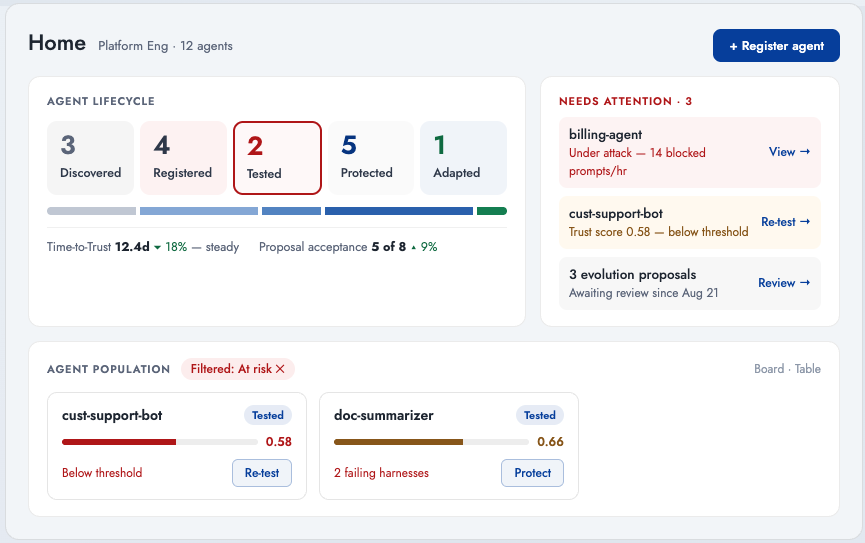
An agent that was safe last quarter is not safe now. The model changed, the tools changed, the adversaries changed. So the work of trusting it never finishes. Vijil runs that loop automatically. Discover gives every agent an identity it can prove. Diamond verifies it with tests on which it never trained. Dome holds the limits it cannot cross. Darwin, now in development, will evolve it inside them.
Each pass leaves evidence the next one uses: Dome’s blocks become Diamond’s probes, and production failures will become Darwin’s targets.
Works wherever you build and run
Every Vijil module drops into frameworks and platforms you already use.
See the integrations Identify
 Verify
 Defend
 Evolve
Harden an agent in two lines
A git-style CLI: porcelain for the lifecycle, plumbing for control — and two lines of code to harden the agent from the inside.
Defends ten of eleven models, and the weakest the most.
On their worst 10% of responses, ten of the eleven score higher with Dome. The median change across all eleven is 17.6 points, and the weakest gain most: Mistral Medium 3.5 by 34.0 and Mistral Large 3 by 27.7. Kimi K3 does not move, 53.7 to 53.6.
Transform feral agents into fiduciary agents.
Start today. No sales call, no credit card. Dome is open source and needs no account: install it and guard a local agent in minutes. The hosted console takes a short form and opens the same day.