
Diamond Adaptive Red Teaming for Agents
Find agentic risks before a real adversary does.
Diamond Adadptive Red Teaming for agents uncovers risk grounded in the agent's own policies and real-world behavior — not just the model behind it — through automated, adaptive, multi-turn attacks that learn across waves in real time, instead of a static snapshot from canned attack tests. It runs before deployment in your own environment, and generates policies for hardening as an integral part of the agentic lifecycle.
The challenge
Agents present new attack paths
that existing approaches don't cover.
Moving agents into production introduces new risks and attack paths. Existing red teaming approaches have focused on compiling responses to a library of single-turn, generic attacks against models — when the real attack surface is the entire agentic system and its dynamic state: its tools, its memory, its multi-turn reasoning, and the policies governing a multi-agent workflow.
Agents are exposed to multi-turn conversational attacks that exploit the agent's identity, mode of operation, and capabilities — none of which static red-teaming libraries can detect. Even for the attacks those libraries do cover, inefficient testing forces a tradeoff between cost and coverage, resulting more in security theater than risk evaluation.
Current red teaming limitations
Incomplete view of risk
Periodic, usually incomplete point-in-time audits using static attack libraries don't cover both direct and indirect surfaces, across session and memory persistence layers.
No multi-turn, multi-agent attack coverage
Real agentic attacks chain across turns, exploiting multiple techniques and paths. Known-risk scans miss the novel failures that emerge from an agent's non-deterministic behavior at different steps in the attack chain.
Isolated from the development and deployment lifecycle
Red teaming is done independently by separate teams, introducing time lags, additional cost, and complexity for developers to act on findings as part of the CI/CD process.
The solution
Adaptive adversarial testing
for agentic risk evaluation.
Diamond Adaptive Red Teaming for Agents is an autonomous set of attacker agents that runs successive attack waves, each wave learning from the results of the previous wave to sharpen attacks in real time. Because attacks are grounded in the agent, its policies, tools, and skills, they are realistic and contextual — rather than generic — and cover both the direct and indirect channels that can be exploited in multi-agent systems.
Once the waves have run, the system generates a structured report and traces that become part of the application development lifecycle, for operational efficiency and improved risk management. Engineering can gradually escalate adversarial intensity depending on cost and relative risk tolerance, and coverage is ensured by a taxonomy of risk categories the user can set or select from a predefined set.
Grounded
Shapes attacks to the agent and its context
Adaptive
Autonomously generates new attacks in real time based on results
Auditable
Produces evidence a stakeholder can read
Cost efficient
Built for the enterprise — runs in a VPC, agent agnostic
Agents vs. agents
The adaptive evaluation cycle.
Given a target endpoint, an agent profile, and a risk taxonomy, each wave generates fresh attack seeds, dispatches a multi-turn attacker per seed, judges every transcript against the agent's actual policies, and reflects on the outcomes to sharpen the next wave.
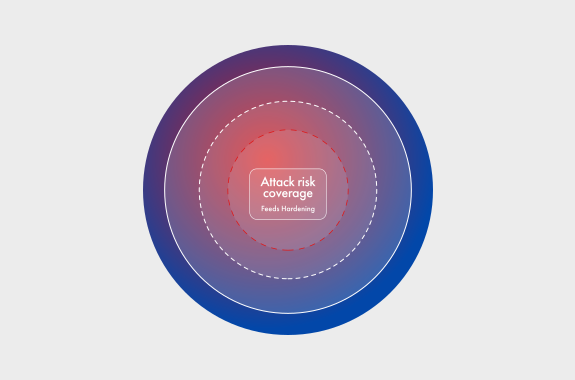
Each wave pushes coverage outward until it saturates — no new findings are identified and every finding feeds the hardening stage that follows.
Agent profile grounding
Attacks and evaluation are shaped by the agent's own tools, policies, and personas.
Attack steering
Automatically generates fresh attack strategies and tests based on what it has learned about the target so far — exploiting known successes and exploring new, unknown areas.
Multi-turn episodes
Runs full multi-turn conversations against the live agent, via direct and indirect attack surfaces.
Adaptive retry
Rolls back and retries a stalled turn, while a prompt optimizer sharpens a message when a line of attack stops working, improving efficiency.
Analysis and self-improvement
Reflects on the outcomes of each wave to sharpen the next wave's attack techniques, continuing until coverage saturates and no new findings emerge.
Why it holds up
Purpose-built to test the whole agent.
Adaptive, multi-turn adversarial testing
Runs full multi-turn conversations specific to the agent, with a full feedback loop on which attacks worked that sharpens an attack when a line of attack is unsuccessful — behavior closer to a persistent human tester than a scripted scanner.
Customize attack taxonomy
Vijil has a set of predefined taxonomies, including OWASP and Vijil's own expanded taxonomy — but can be pointed at any operator-supplied vulnerability and risk catalog, with findings tracked by risk category so governance teams can assess coverage.

Automates for cost efficiency
No lengthy professional services engagement required. Findings are managed through an integrated console as part of the agentic lifecycle, with no platform dependencies.
Integrated — evaluation feeds hardening
Where DART sits in the agent
trustworthiness lifecycle.
Registration after discovery scans establishes that an agent is known and governable. Evaluation answers the question governance, security, and compliance teams actually need before a deployment decision — not whether the agent was configured correctly, but whether it holds up when someone tries to break it.
Adaptive Red Teaming consumes the agent profile — its tools, policies, and personas — to shape the attack. The resulting report and trace telemetry become the evidence base for the Protect stage, where hardening and guardrails are implemented to mitigate the identified risks and vulnerabilities.
Built for real deployment
Production-hardened,not a
research prototype.

Runs unattended on real customer load with rate limiting, retries, and per-role model configuration.

Deployable via agent ADK or a long-running A2A server, packaged as a single Docker image.

Externally configurable storage, rate limits, retries, and per-role models.

Integrated into the Vijil console for real-time use.
.svg)
Agent agnostic — supports all agents, with no platform dependencies.

Runs in your VPC or fully on-premise for air-gapped and regulated environments.
Market dynamics
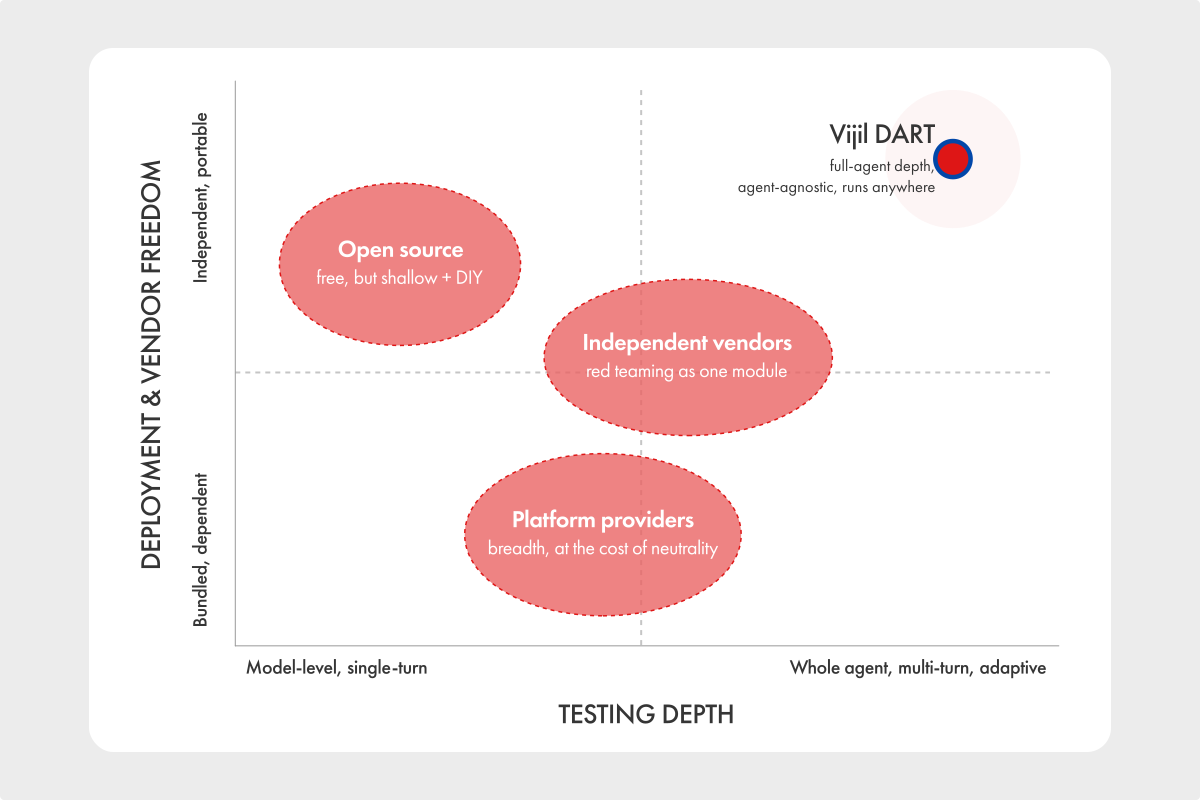
Three kinds of alternative. Three different gaps.
Independent point vendors
Agent-security startups with unified suites
Their strength
Unified suites — discovery, posture, access control, runtime defense — with strong momentum and, in some cases, deep research pedigree.
Where DART is different
Depth of adversarial method. Cross-wave, taxonomy-tracked multi-turn search grounded in the target's own agent profile — not red teaming as one module inside a posture-and-runtime bundle, and not a SaaS-only footprint.
Platform providers
Network and model platforms that acquired an evaluation layer
Their strength
Enormous enterprise distribution and one-vendor accountability, having acquired the evaluation layer into a much broader security or model platform.
Where DART is different
Neutrality. An evaluator that doesn't also sell you the model, the network, or the stack underneath the agent — agent agnostic, with no platform dependencies, for buyers who aren't already standardized on one suite.
Open source
Developer-led evaluation frameworks
Their strength
The largest developer footprints in the category, free to start, and easy to wire into an existing test suite.
Where DART is different
Automation instead of assembly. Adaptive multi-turn waves that run unattended on real load, findings managed in an integrated console, and no lengthy professional services engagement to make it work.

