Most regulated and security-conscious organizations already have a definitive answer to the question of: "where do our data, logs, and security events live”. Adoption of AI technologies introduces new classes of data from inference and reasoning traces, guardrail actions, policy violations, prompt inputs and outputs, behavioral traces, as well as system logs. Where that data ends up is now of some immediate concern to compliance and governance teams.
Sending prompts, tool outputs, and agent reasoning traces to an external evaluation service - even when they are certified as compliant with the SOC 2 framework, for example - potentially expands the attack surface, complicates data residency and sovereignty reporting, and sets in motion another vetting process.
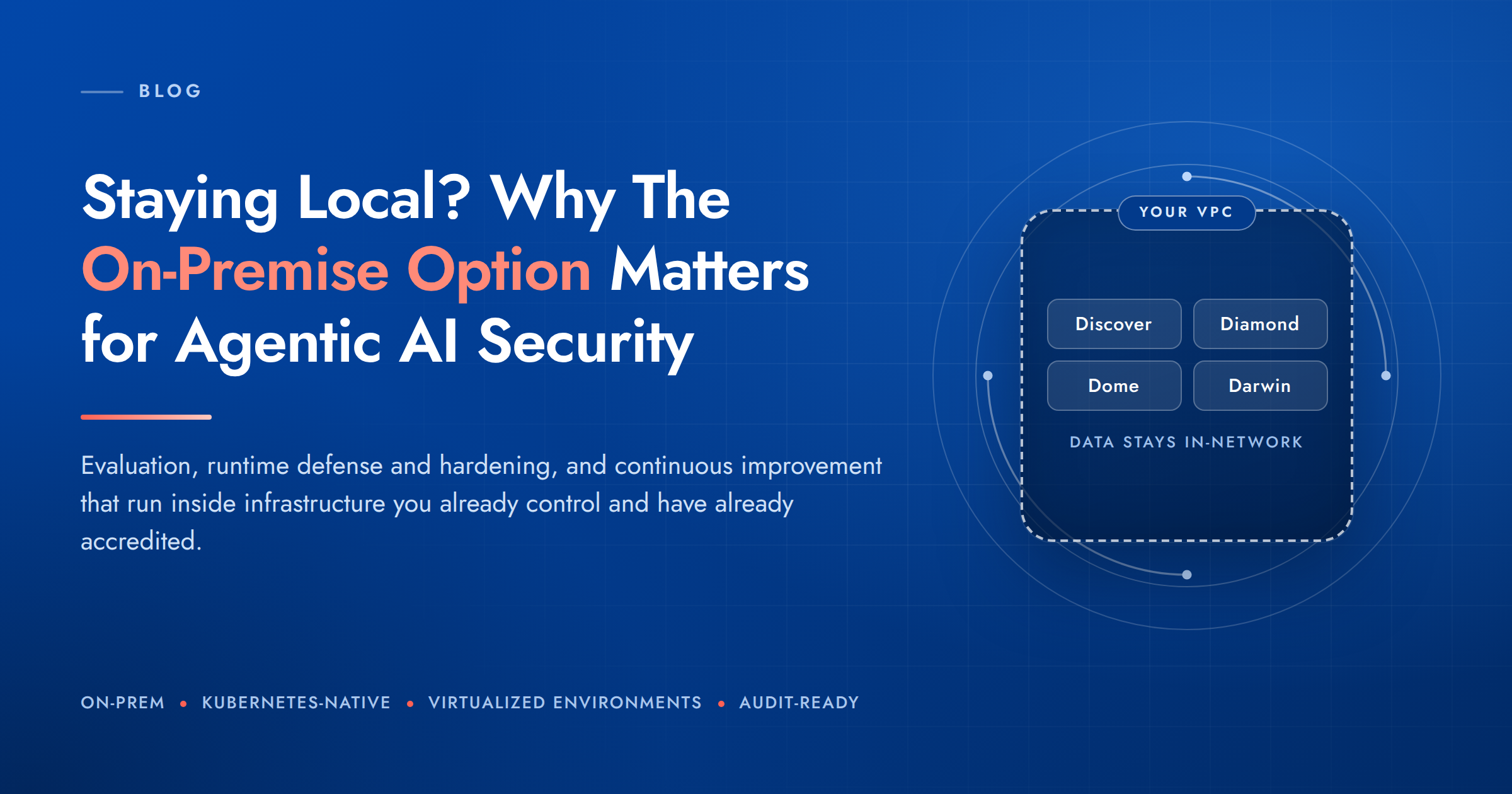
Vijil's deployment model was designed as on-premise first - precisely because of those concerns. Detection models and controls run in-network.
Using the Kubernetes-native patterns and components which engineers are already are familiar with, the Vijil platform can be instantiated in a hyperscaler VPC (AWS, Microsoft Azure or Google Cloud Platform) and managed through the platform’s tool - or through standard Kubernetes management tooling and patterns for self-managed infrastructure, including support for SPIFFE cryptographic credentials. The platform components can also run in VMware virtualized environments, in on-prem datacenters, or in air-gapped networks.
The data, traces, and logs from Vijil’s rigorous agent evaluation, robust policy enforcement and monitoring, and continuous improvement proposals stay within direct enterprise control. That means compliance and risk owners have an answer to data residency and sovereignty concerns, and can potentially progress with deployment of trustworthy agents more quickly than they would with a platform delivered as SaaS.
The governance problem with cloud-only AI security and governance
Financial services firms, healthcare providers, government entities, and large enterprises operating under frameworks like the EU AI Act, NIST's AI Risk Management Framework, or ISO 42001 need to demonstrate not just that their AI systems behave safely, but that the process of proving it doesn't itself introduce a new data-handling risk.
Even when those services carry a SOC 2 report or another familiar compliance certification, the concern doesn't fully go away, since AI agents are a new technology class producing data, reasoning traces, and behavioral telemetry that existing frameworks weren't written to classify or govern. A certification built for conventional application logs and customer records doesn't automatically tell a risk officer what it means to store a record of an agent reasoning its way through a jailbreak attempt, or a trace of exactly how it handled a customer's sensitive data mid-task.
This means security teams and compliance teams will need to review the vendor's subprocessors, retention policies, and breach history before they can even start testing whether the agent itself is safe. For a chief risk officer or a CISO, that's an uneasy trade: accepting new exposure in order to measure and reduce exposure elsewhere.
On-prem deployment lightens the load. When the evaluation and defense layers run inside infrastructure the organization already controls and has already accredited, governance teams aren't being asked to extend trust to a new environment. They're extending existing controls, existing network boundaries, existing audit processes, to cover a new category of system.
How Vijil implements it
Vijil's architecture treats self-hosting as a first-class deployment option rather than an afterthought bolted onto a SaaS product. In practice, that looks like:
- Full component parity in your VPC. Discover, Diamond (evaluation and adaptive red teaming), Dome (real-time policy enforcement, typically operating in the low tens of milliseconds), and Darwin (the reinforcement-learning layer that hardens agents against observed production attacks) as well as the management console all deploy within the customer's own compliant network, with no external proxies or added data-transfer hops.
- Kubernetes-native deployment. Every component ships as containerized services that install into the customer's existing Kubernetes cluster rather than a bespoke appliance or VM image. That means the platform inherits whatever the organization already runs for cluster security and operations, network policies, service mesh, RBAC, image scanning, and it slots into existing infrastructure-as-code and CI/CD pipelines instead of requiring a separate provisioning process. Scaling, upgrades, and failover follow the same patterns teams already use for the rest of their workloads, so on-prem trust infrastructure doesn't become a special case operationally.
- A minimal, auditable integration footprint. Rather than requiring broad access to internal systems, the platform needs only HTTP endpoint access, scoped service accounts for the tools it evaluates, so security teams can review exactly what the platform touches and why.
- Policy translation, not policy replacement. Governance requirements, whether they come from internal risk policy, a regulator, or an industry standard, get translated into concrete evaluation test cases and guardrails that run against and harden the agent continuously, from development through production. The rules of engagement are the organization's own; Vijil operationalizes them rather than imposing a generic rubric.
- Audit-ready output by default. Every evaluation run, policy enforcement decision, and improvement cycle produces documentation designed to hold up in a compliance review, giving legal and risk teams objective evidence, not just a vendor's assurance, that an agent stayed within its safety boundaries.
Because the on-prem deployment carries the same feature set as the hosted version, teams aren't forced to choose a "lite" version of the product to satisfy data residency. They get the same testing depth against thousands of adversarial prompts, the same runtime defenses, and the same continuous-improvement loop, just running on infrastructure they already control.
What this means for agentic adoption
The practical benefit shows up first in procurement and security review cycles. When the evaluation platform runs inside the customer's own network boundary, it inherits controls the organization has already built and is part of an audit process. The delivery model potentially decreases the likelihood that AI initiatives which would otherwise get parked waiting on a security exception or regulatory assessment can move forward on a normal timeline.
Finally, there's a simpler, less regulatory benefit: control over the roadmap of trust itself. Because Darwin continuously learns from production attacks and failures to strengthen agent defenses, and because that learning happens on the customer's own infrastructure, the resulting improvements, and the data that produced them, stay inside the organization. Enterprises are running a closed loop that gets smarter over time without ever having to send their most sensitive operational data somewhere else to do it.
As AI agents take on more consequential work, hiring decisions, financial transactions, infrastructure changes, the question stops being "is this agent impressive" and becomes "can we prove this agent is safe, to the standard our regulators, our customers, and our own board expect." On-prem deployment is Vijil's answer to the part of that question.
Check out the Vijil architecture and deployment approach in our docs.
And, schedule a discussion to learn more about the Vijil platform.
.png)