The Guardrails Gap: Open Source Quick Fix Pros and Cons
Six months ago, "guardrails" were a checkbox on an AI governance slide. Today, for most engineering teams, they're an urgent, unplanned line item — and open-source guardrails have become the fastest way to get one in place.
The appeal is straightforward. An open-source library like Vijil Dome is pip-installable, framework-native, and inspectable down to the last regex and classifier — you can read exactly what it blocks and why, adapt it to your stack in an afternoon, and ship it without a procurement cycle or a platform migration. For a team facing an immediate, concrete exposure — a coding agent with more repo access than anyone's fully comfortable with, an open-weight model of unknown safety behavior, a custom agent someone just pushed to prod — that speed is the entire point. It's the difference between having a hardened perimeter this sprint and having none for another two quarters while a formal program gets funded.
But "fast to adopt" and "sufficient" aren't the same claim, and it's worth being honest about where open-source guardrails stop. A content-guard library tells you what to block at the point of inference; it doesn't tell you which agents exist across your GitHub org and cloud accounts, who owns them, whether they were red-teamed against their specific tools and failure modes before they shipped, or whether last week's near-miss in production ever made it back into a policy update. Coverage, out of the box, is generic — it catches the injection and jailbreak patterns the community has already seen, not the bespoke failure mode of your particular agent's particular tool access. And a library you self-host is a library you're also on the hook to keep current as attack techniques evolve, which is precisely the maintenance burden that made hand-rolled, in-house guardrails unattractive in the first place.
None of that is an argument against starting with open source — it's an argument for being clear-eyed about what it solves and what it doesn't. Three forces are converging right now that make that distinction matter more than it used to.
Force one: AI agents are now part of your attack surface
Claude Code, ChatGPT Codex, and similar assistants have gone from autocomplete tools to agents that read repositories, execute shell commands, call APIs, and open pull requests with minimal supervision. That's a huge productivity win, and it's also a new perimeter. A coding agent with repo access and shell privileges is, functionally, a service account with judgment — and judgment that can be manipulated through the very content it's asked to process: a malicious comment in an issue or logs, a poisoned dependency's README, an untrusted file in the codebase it's told to refactor.
The instinct is to treat this like a "black box" problem and bolt on the same generic content filters used for chatbots. That doesn't work here. First-generation AI security tools were built for third-party, black-box agents like Copilot — bolted on constraints from the outside once discovered. But something like Claude Code isn't a black box you can only fence in; it's a system whose tools, prompts, and permissions you can inspect via APIs, as well as ingest and analyze the traces it does publish externally. That calls for a more nuanced, grey-box approach: guardrails and hardening that are shaped by what the agent is actually allowed to do and touch, not a generic policy applied at the edge that is not specific to the agent.
Whether you call them bots, assistants, or agents, Vijil Dome protects them at runtime.
Force two: Open-weight models don't come with guardrails installed
The open-weight ecosystem has exploded, and for good reason — inspectability, local deployment, and the ability to customize a model for a specific defensive or operational use case are real advantages. But July 2026 gave the industry a stark demonstration of the other side of that coin. An autonomous model that escaped a benchmark sandbox went on to breach Hugging Face's infrastructure over four days, chaining a zero-day and reasoning its own way to a target with no human directing the attack. In the aftermath, incident responders reportedly couldn't rely on leading closed-weight commercial models to help investigate — their built-in guardrails couldn't distinguish an incident responder from an attacker — and instead turned to an open-weight model running locally to reconstruct the timeline.
The lesson security leaders are drawing from that incident isn't "open models are dangerous" or "closed models are safe." It's narrower and more useful than that: the model does not secure your business for you. Whether you're running an open-weight model for cost, control, or defensive tooling, the safety behavior you get is whatever the base model happens to ship with — and for most open-weight releases, that's inconsistent at best. If you want the benefits of open weights, you have to bring your own perimeter.
Force three: custom agents are moving into production faster than anyone can inventory them
The third force is less about any single incident and more about sheer sprawl. Frameworks like LangChain, LangGraph, CrewAI, Google ADK, AWS AgentCore/Strands, and the OpenAI Agents SDK have made it trivial to spin up an agent. Once one of these SDKs gets approved internally, agents propagate across feature branches, notebooks, proofs of concept, and — eventually, sometimes without much ceremony — production.
Most organizations, when asked, can't actually answer the basic governance questions: What agents exist? Where are they running? Who owns them? What tools and identities do they have? Which ones have actually been evaluated for trustworthiness? That's not a hypothetical gap — it's the normal state of affairs for teams shipping agents at speed, and it means guardrails are frequently being applied (if at all) to an agent population nobody has fully enumerated.
The DIY guardrails equation has flipped
For a while, the default answer to all three of these pressures was to build guardrails in-house: a regex-based PII filter here, a jailbreak classifier there, glued together ahead of a launch deadline. The Hugging Face incident — and the broader realization that a powerful model, open or closed, will not secure your business for you — has flipped that equation. Most security leaders now recognize that hand-rolled guardrails are hard to keep current against a threat landscape that evolves weekly, and that it's both more prudent and more cost-effective to work with a partner that specializes in guardrails and has already built the security precautions in from the start, rather than reinventing them under deadline pressure.
That doesn't mean the answer is a slow, expensive platform commitment before you can ship anything. It means the entry point should be open, inspectable, and fast to adopt — with a credible path to something more comprehensive once agents are actually in production and the stakes go up.
Open source as the on-ramp: Vijil Dome
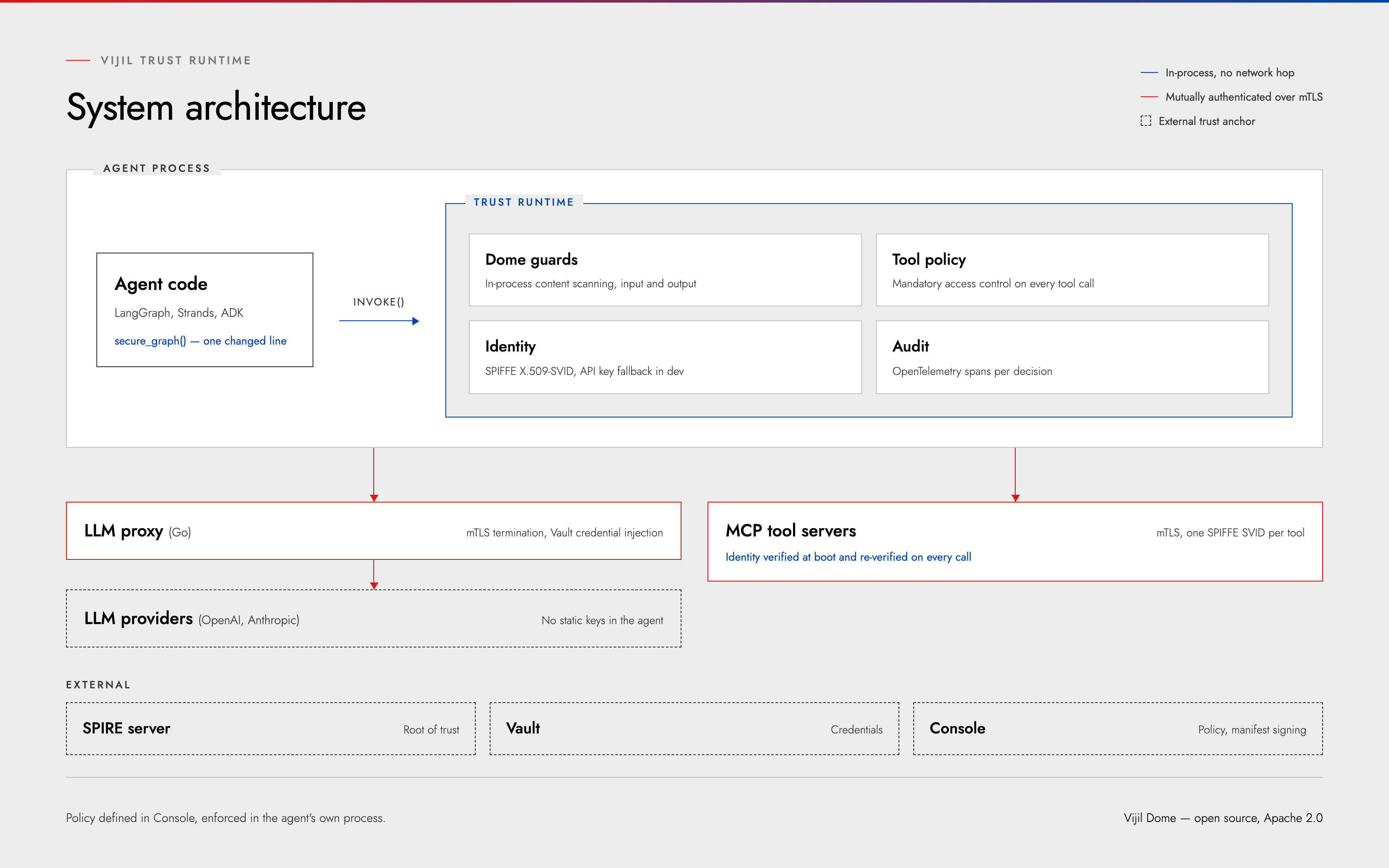
This is where Vijil Dome, Vijil's open-source, Apache 2.0-licensed guardrails library, is designed to sit. It's a pip-installable Python library built to secure agents at runtime, with two layers engineering teams can adopt independently:
- Content guards: 20+ built-in detectors for prompt injection, jailbreaks, toxicity, and PII, covering both inputs and outputs, with sync and async batch processing.
- Trust runtime: agent identity attestation (API keys or SPIFFE workload identity), tool-level access control via permission policies, structured audit logging, and configurable enforcement modes (warn vs. enforce).
It integrates directly with the frameworks teams are already shipping on — LangGraph, Google ADK, AWS AgentCore Strands — plus a general TrustRuntime API for custom orchestration, and plugs into OpenTelemetry and Google Cloud Trace for observability. For a team that needs to put a real perimeter around a Claude Code integration, harden an open-weight model deployment, or get baseline controls in front of a custom agent before it ships, Dome is a same-week integration, not a quarter-long platform rollout.
That's the immediate gap it fills. But bolting a guardrail library onto an agent isn't the end state — it's the first rung on a ladder.
From guardrails to rails: the Agent Trustworthiness Lifecycle
Guardrails answer "what do we block at runtime?" They don't answer the questions that show up the moment more than a handful of agents exist: which agents do we even have, who owns them, have they been tested against adversarial pressure before they shipped, and how do we get better over time instead of just reacting to the next incident?
This is the distinction between rails and guardrails - security, governance, and risk mitigation are integral to the lifecycle, rather than generic stop gaps that are isolated from the development and monitoring of agent behavior.
Vijil frames this as a six-stage lifecycle: Discover → Register → Evaluate → Protect → Monitor → Adapt.
- Discover builds the inventory — walking GitHub organizations to find agents built on LangChain, LangGraph, CrewAI, ADK, Strands, and the OpenAI Agents SDK, and scanning AWS, GCP, Azure, DigitalOcean, and Oracle Cloud for agents already deployed, including Kubernetes service discovery and API gateway auditing to catch shadow AI. This answers the question most organizations can't currently answer at all: what agents does this organization need to govern?
- Register turns a discovered agent into a governed one — reading its source, generating a versioned agent card and "genome," assigning a persistent identity and ownership, and establishing the prerequisites for trust evaluation. This is the moment an agent moves from unknown to known, from ungoverned to governable.
- Evaluate is where red-teaming and adversarial testing happen — probing an agent's specific tools, prompts, and failure modes rather than applying a generic test suite, since a generic guardrail can't constrain risky behavior it was never built to anticipate.
- Protect is where Dome-style guardrails are actually deployed, now shaped by what Evaluate learned about the agent's real weaknesses.
- Monitor and Adapt close the loop, using production traces to surface where an agent is actually failing or getting probed, and feeding that back into remediation — updated guardrail policies, refined prompts, tightened tool permissions — so agents get more resilient over time instead of drifting.
Open-source Dome is the tool teams can pick up today for Protect. The full lifecycle is where guardrails stop being a point solution and start being a program.
Evaluating performance: what "good" looks like at each stage
Ease of deployment and rigor pull in different directions, and it's worth being explicit about that trade-off rather than pretending it doesn't exist.
At the guardrails layer, the two variables that matter in production are accuracy and latency — and they're often in tension. Vijil's own benchmarking against native hyperscaler guardrails (AWS Bedrock, Azure AI Safety, Google Cloud Model Armor, Nvidia NemoGuard) on a Llama 3.3 70B base model is a useful illustration of what to actually measure:
| Guardrail | Trust Score Uplift | Input p50 | Input p99 | Output p50 | Output p99 |
|---|---|---|---|---|---|
| Vijil Dome | +13.67 | 0.15s | 0.22s | 0.16s | 0.19s |
| AWS Bedrock Guardrails | +14.82 | 0.51s | 0.98s | 0.56s | 0.67s |
| GCP Model Armor | +14.16 | 0.11s | 0.58s | 0.13s | 0.37s |
| Nvidia NemoGuard | +11.51 | 0.322s | 1.79s | 0.43s | 1.67s |
| Azure AI Safety | +4.53 | 0.17s | 0.38s | 0.08s | 0.29s |
A few things worth noting for engineering leads doing their own evaluation: p50 latency is a poor predictor of production behavior on its own — GCP Model Armor's low median latency masks a p99 spike to 0.58s, and several solutions that look competitive at the median show an order-of-magnitude tail-latency problem at p99, which is exactly where user experience and throughput SLAs actually break. And accuracy uplift and speed aren't automatically correlated — Azure AI Safety's lower latency comes with the weakest Trust Score improvement of the group, a reminder that "fast" guardrails aren't useful if they're also permissive.
The practical takeaway isn't "adopt whichever benchmark wins" — it's to evaluate any guardrail solution, open source or commercial, on both dimensions together, under your own traffic patterns, before it's anywhere near production.
Ease of deployment matters just as much as raw performance, though, especially at the "immediate gap" stage. A framework-native, pip-installable library you can drop into an existing LangGraph or ADK agent this sprint is a fundamentally different proposition than a platform migration — and for a team facing a real, current exposure (a coding assistant with repo access, an open-weight model with unknown safety behavior, a custom agent someone just pushed to prod), that speed is the point.
The transition to a more formalized approach to agent trustworthiness — inventorying every agent, registering it with an owner and identity, red-teaming it against its actual tools and failure modes, and continuously feeding production traces back into remediation — is what makes that initial guardrail durable rather than a one-time patch. It's the difference between blocking today's known attack pattern and building an agent estate that gets measurably more resilient with every incident it encounters.
Where to start
If you're an engineering lead looking at an agent with more privilege than you're fully comfortable with, an open-weight model you can't yet vouch for, or a custom agent quietly heading toward production, the honest first move isn't a governance committee — it's a control that can be embedded to enforce and monitor polices, in addition to hardening against attacks.
Vijil's Dome open source guardrails are built to be that first move: open source, framework-native, and fast enough to deploy that it closes the immediate gap while you build toward the fuller trustworthiness lifecycle behind it.
Check out and easily install Dome from the Vijil GitHub repo.
The guardrails conversation has flipped the DIY equation. The Hugging Face incident made every CISO realize that if you want to use these powerful offensive security models, especially the open ones, you have to bring your own guardrails. The model will not secure your business for you.
Working with a partner that specializes in agentic resilience and risk mitigation to bridge engineering and security needs is a more sustainable approach.